
By Carl Edwards
After more than 20 years working with reporting and business intelligence platforms, I’ve noticed something interesting.
Most users don’t actually want analytics. They want answers. That might sound like the same thing, but I don’t think it is.
For years, traditional BI focused on giving people better access to information. Dashboards became more powerful. Reports became more interactive. Self-service tools promised to put data into everyone’s hands. And to some extent, they succeeded. The problem is that access was never the real goal. Understanding was.
We’ve Solved Access. We Haven’t Solved Understanding.
Most organisations now have more data than ever before. More reports, dashboards, KPIs, visualisations, etc.
Yet people still spend a surprising amount of time asking questions like:
-
- Why did that number change?
-
- What caused that spike?
-
- Is this normal?
-
- What should I look at next?
-
- Can I trust what I’m seeing?
The challenge isn’t finding information anymore. The real challenge is making sense of it. That’s why so many users still end up exporting data to Excel. Not because they love spreadsheets, but because they’re trying to answer questions the software hasn’t fully answered for them.
The Hidden Frustration Nobody Talks About
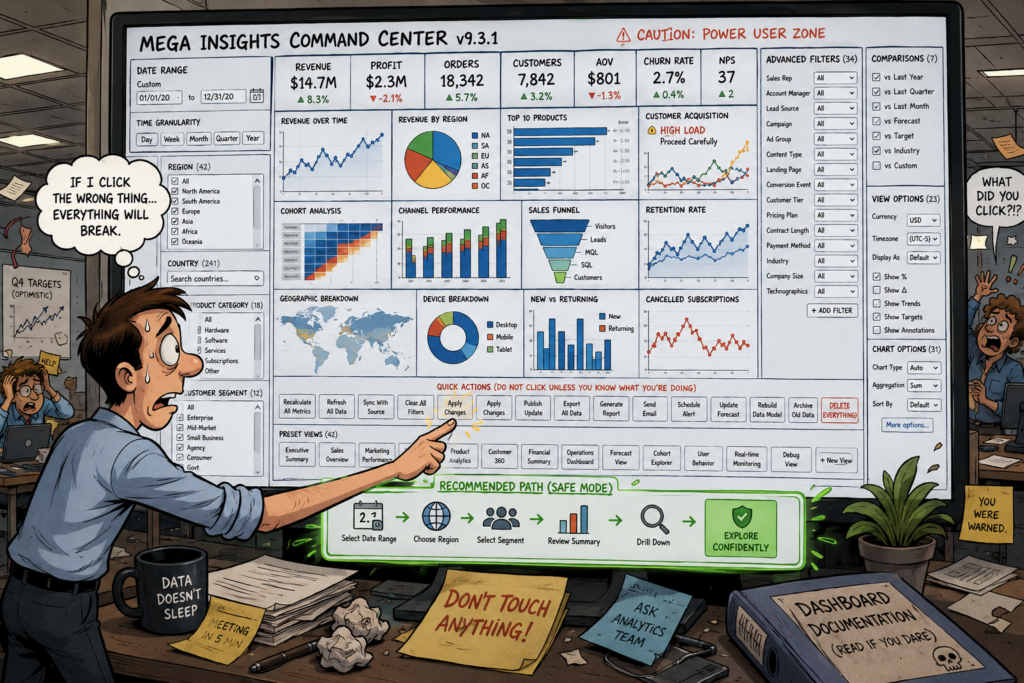
There’s another issue I’ve seen repeatedly over the years. Many business users tend to fall into one of two camps. The first group can’t get the answers they need without involving the BI or data team. The second group has access to the data but worries they might misinterpret something, build the wrong report, or accidentally break a process that someone spent months putting together.
Neither situation is ideal. People don’t want unlimited freedom with data. They want confidence. Confidence that they’re looking at the right information. Confidence that the numbers are trustworthy. Confidence that they can explore without breaking something.
Why Expectations Are Changing
Twenty years ago, software helped people complete tasks. Today, users increasingly expect software to help them understand what’s happening too. That’s a subtle but important shift.
Customers don’t just want to process an order, manage a customer, or track a shipment. They want clearer visibility. They want context. They want to understand what’s driving performance without leaving the application they’re already using. That’s one of the reasons embedded analytics has become such an important part of modern products.
Where Embedded Analytics Fits
Embedded analytics isn’t really about adding another dashboard. At least, it shouldn’t be. The best implementations don’t feel like reporting tools at all. They feel like a natural part of the product.
Users don’t need to export data. They don’t need to open spreadsheets. They don’t need to wait for reports to be built. The information they need is available exactly where decisions are being made. Not as an afterthought, but as part of the experience.
The Real Opportunity
A lot of today’s discussion focuses on AI, copilots and conversational analytics. Underneath all of that, I think the real trend is much simpler. People are tired of playing detective.
They don’t want more charts. They don’t want more dashboards. They want to understand what’s happening and why.
The products that succeed over the next few years won’t necessarily be the ones with the most features. They’ll be the ones that reduce uncertainty. The ones that help users move from information to understanding.
And that’s why I believe the future of analytics isn’t about giving people more access to data. It’s about giving them the confidence to explore it.